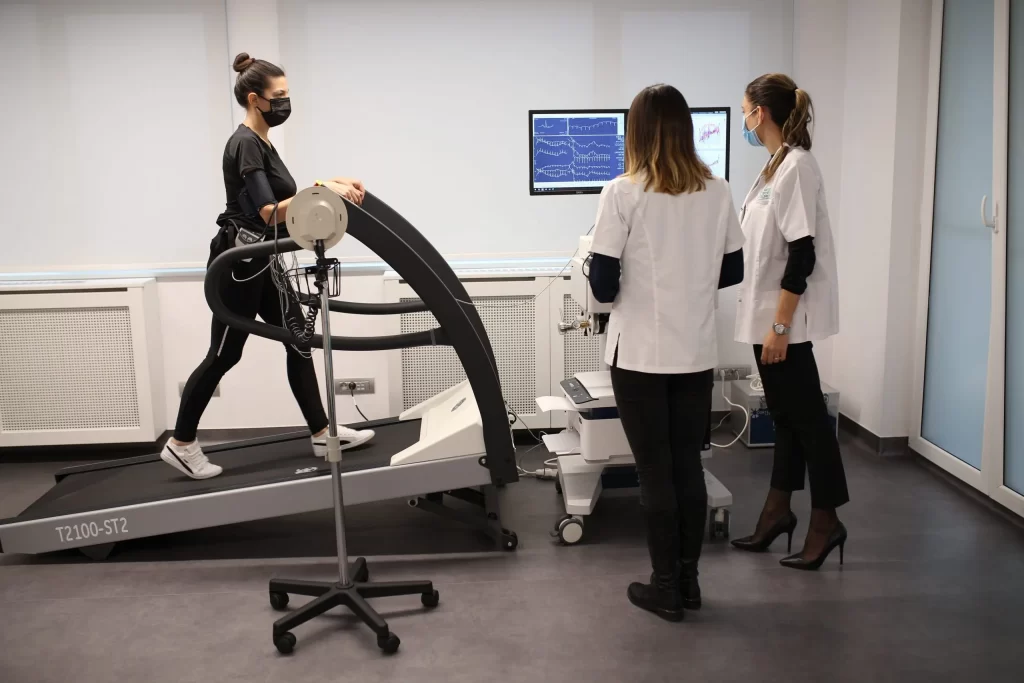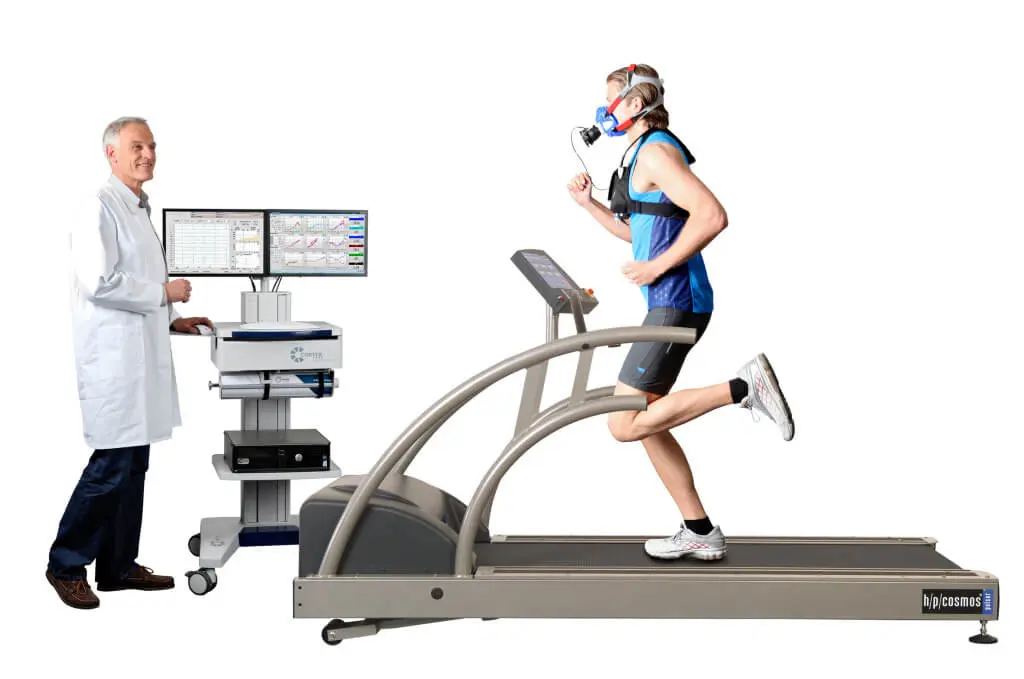
Cardiopulmonary exercise testing (CPET) is the gold standard for cardiorespiratory functional assessment. It is a valuable and essential tool that can reduce the time and costs required to diagnose conditions that limit exercise capacity. It provides information superior to that obtained at rest, allowing a better functional assessment of the cardiovascular and respiratory systems.
What is cardiopulmonary exercise testing (CPET)?
Cardiopulmonary exercise testing (CPET) is an advanced, specialised investigation that provides complex information about the exercise capacity of the person being tested. This test offers a combined, parallel analysis of data that allows a complete assessment of the cardiovascular, respiratory, muscular and metabolic systems during exercise. The main function of the cardiovascular and respiratory systems is to ensure gas exchange between the cells of the body and the external environment.
It is a non-invasive procedure carried out on a treadmill or exercise bike. The patient breathes through a mask, and both the heart rhythm (by electrocardiogram) and the dynamics of the respiratory gases (oxygen and carbon dioxide) during exercise are monitored simultaneously, together with the relationship between them and their relationship with heart rate and pulmonary ventilation.
Measuring gas exchange is fundamental to understanding the pathophysiology of exercise limitation. It provides essential information for the integrated assessment of the cardiovascular, respiratory, muscular and metabolic systems. As a result, the cardiopulmonary exercise test can answer more questions than an exercise test that uses only an electrocardiogram.
CPET assesses individual exercise capacity and provides important diagnostic and prognostic data.
What does cardiopulmonary exercise testing (CPET) involve?
Cardiopulmonary exercise testing (CPET) is carried out using a face mask or a mouthpiece. The air breathed is directed through a volume sensor that records all the physical characteristics of the person's breathing.
Through a suction system connected to it, air samples can be taken at regular intervals (breath by breath) from the person's respiratory flow. These are analysed to determine the levels of oxygen and carbon dioxide.
In the field of sports medicine, gas exchange (spiroergometric) measurements are used for several purposes:
- in assessing endurance capacity,
- in determining the costs of energy production
- investigating limitations in performance
The cardiological assessment remains the responsibility of the consultant cardiologist.
What is measured during cardiopulmonary exercise testing
Endurance testing is the largest area of application. The indicators of endurance capacity are maximal oxygen uptake (VO2) and the ventilatory thresholds (VT1 and VT2). In addition, anaerobic capacity, movement economy and mechanical efficiency can also be determined through gas exchange measurements.
Cardiopulmonary exercise testing also defines, at the same time, the exercise intensity zones that are then used in training. These intensity levels can be, and are, individualised for each subject tested, greatly reducing the risks of chronic fatigue and declining performance.
The energy costs during physical activity and the ratio of fat to carbohydrate metabolism can be assessed by indirect calorimetry.
When is cardiopulmonary exercise testing (CPET) recommended?
Establishing a differential diagnosis
- when the cause of dyspnoea (difficulty breathing) or exercise intolerance is not known, CPET helps to establish whether the exercise limitation has a cardiovascular, pulmonary or muscular origin
- detecting or ruling out exercise-induced myocardial ischaemia by analysing gas exchange, especially when the electrocardiogram cannot be interpreted
Assessing functional capacity
- provides objective information about exercise capacity and the degree of impairment
- prescribing training to improve performance in athletes
Assessing patients with heart conditions
- for assessing severity and prognosis in heart failure
- within cardiac rehabilitation programmes, for prescribing physical training and the level of exercise the patient can safely perform. Improvement in exercise tolerance can only be objectively assessed with CPET cardiopulmonary exercise testing
- for assessing the effectiveness of drug treatment and evaluating functional improvement after pacemaker implantation in patients with heart block
- selecting patients for heart transplantation
Determining preoperative risk
In patients who are due to undergo major surgery, cardiopulmonary exercise testing provides more information about cardiovascular and pulmonary reserve under metabolic stress than a cardiovascular and ventilatory assessment carried out at rest.
Assessing patients with respiratory conditions
- chronic obstructive pulmonary disease
- interstitial lung disease
- pulmonary vascular disease
- establishing the degree of functional impairment
- determining the degree of hypoxaemia and the need for oxygen therapy
- determining the response to treatment
- exercise-induced bronchospasm
Interpreting the results of cardiopulmonary exercise testing
Pulmonary gas exchange (VO2, VCO2, VO2 max).
Oxygen uptake (VO2) is the volume of O2 extracted from the inhaled air during pulmonary ventilation per unit of time, and is expressed in ml.min – 1 or L.min – 1 (STPD).
Pulmonary ventilation (VE), expressed in litres per minute. This is the volume of air moving in and out of the lungs. It is determined as the product of the respiratory rate and the volume of air exhaled in each respiratory cycle. The respiratory quotient or respiratory exchange ratio (R): expresses the ratio between CO2 production and O2 uptake (VCO2/VO2). At present, this is the best non-invasive indicator of maximal or near-maximal exercise intensity.
(VE/VO2) and (VE/VCO2) represent the ratios between pulmonary ventilation and O2 uptake (VE/VO2) or CO2 production (VE/VCO2). These coefficients determine the anaerobic threshold (AT), the RCP (respiratory compensation point), indirect calorimetry (VO2, VCO2, RQ) with a mask, resting energy expenditure (REE, RMR) and maximal voluntary ventilation (MVV).
Cortex MetaLyzer 3B
Ergospirometry plays a vital role in the efficient, non-invasive testing of respiratory function, cardiac function and metabolism in a single investigation. The predictive parameters for respiratory function, cardiac function and metabolism can be determined simply and quickly by testing with the innovative Cortex MetaLyzer 3B system.
Using the Cortex MetaLyzer 3B system in ergospirometry has multiple benefits. These include the following:
- It is a non-invasive procedure that provides feedback on performance and exercise tolerance in everyday life, for sports training and for medical rehabilitation (rehabilitation medicine, physical medicine and balneology)
- It rapidly identifies cardiovascular, cardiorespiratory and metabolic functional deficits, while also allowing rapid adjustments to training programmes and methods
- The data recorded are objective, relevant and more comprehensive than those obtained by measuring lactate levels and heart rate.
Before cardiopulmonary exercise testing, it is advisable not to eat for at least four hours beforehand and to avoid caffeine-based products. And if you are wondering how long the exercise test takes, you should know that the actual exercise part lasts less than 15 minutes. The effort is increased gradually, from normal walking to running, but the duration of the test is personalised. It will not exceed one hour, and the doctor may stop the test if severe symptoms appear.
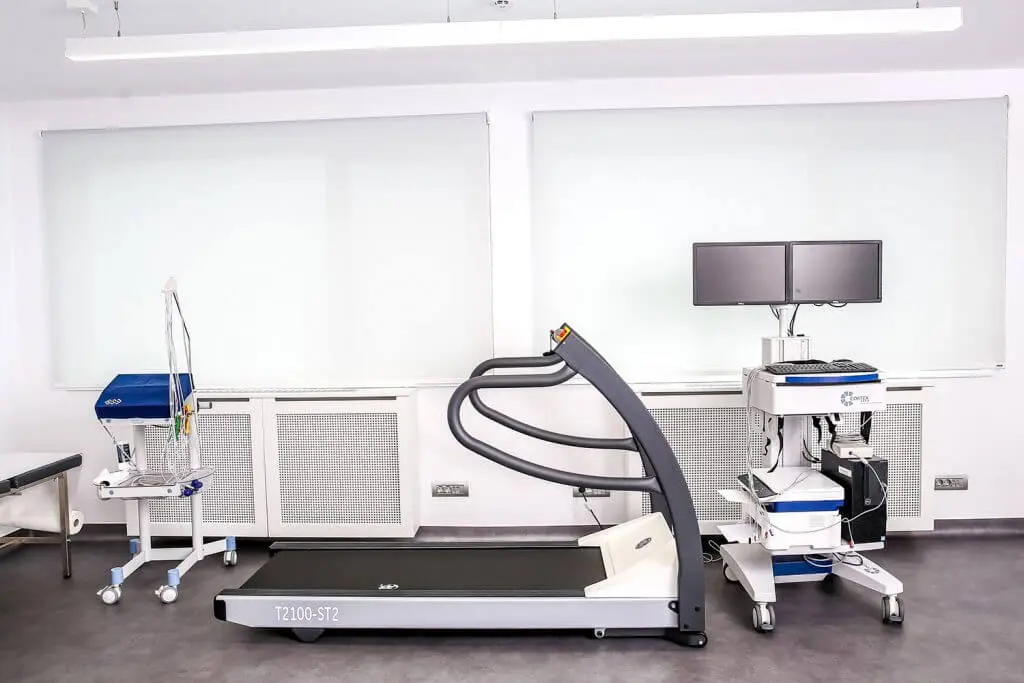
Cortex MetaLyzer 3B
Cardiopulmonary exercise testing (spiroergometry or CPET) provides a combined, parallel analysis of data that allows a complete assessment of the cardiovascular, respiratory, muscular and metabolic systems during exercise, and is considered the gold standard for cardiorespiratory functional assessment.
Find out moreNewsletter subscription
Sign up for the Artro Sport newsletter free of charge!