Sudden death is the reason why young people in excellent physical condition, with no apparent illness, have collapsed out of the blue on the pitch. The proportion of athletes who have suffered sudden death is not as high as we might imagine (3 per 100,000). However, the emotional impact of such a tragedy, covered across various media channels, is enormous.
Patrick Ekeng, Cătălin Hâldan, Michael Klein – capped 90 times for the Romanian national team – are just some of the footballers who quite literally gave their lives on the pitch or in training. Tragedies of this kind have occurred at many renowned clubs across Europe, as well as among basketball and American football players.
What is sudden death syndrome?
Sudden death can occur not only in elite athletes but in anyone who engages in intense physical activity without knowing the limits of their body's endurance, especially if they are not aware of suffering from any illness. Sudden death can also occur during sleep. In these cases, sudden death accounts for 20% of overall mortality.
The causes of sudden death are generally cardiac in origin, although they can also be of a different nature:
- caused by environmental factors
- hypothermia or hyperthermia
- brain or spinal injuries
- aneurysm
- accidental blows
Sudden death syndrome in infants
Unfortunately, sudden death syndrome can also affect infants up to 1 year of age. In general, sudden infant death syndrome occurs between the second and fourth month of life, during sleep. It is called sudden death because it can be neither predicted nor prevented and, most often, the causes remain unexplained even after complex tests. Boys have been observed to be more affected by sudden death syndrome than girls.
Although there is no cause unanimously accepted by the medical community, the risk factors for sudden infant death syndrome are recognised. Low birth weight, prematurity and a lack of maternal care during pregnancy are some of the risk factors.
Sudden infant death syndrome cannot be prevented, because it has no obvious symptoms. Babies appear healthy before going to sleep and show no signs of illness. Moreover, they cannot be resuscitated.
Doctors recommend good care during pregnancy and putting the baby to sleep on its back. It is not a bad idea for the baby's cot to be as close as possible to the parents' bed during the first four months of life. The room in which the infant sleeps should be well ventilated and overheating should be avoided. Although sudden infant death syndrome cannot be prevented, a decrease in the frequency of these cases has been observed among infants put to sleep on their backs, on a ventilated mattress.
Sudden death during intense physical exertion
The most common cause of sudden death is a heart rhythm disorder (arrhythmia) brought on by intense physical exertion in the presence of hypertrophic cardiomyopathy, a genetic condition that causes thickening of the heart walls. Congenital abnormalities of the coronary arteries and commotio cordis are other causes of sudden death. The latter occurs following a blow to the chest over the heart, not necessarily a hard one. It is therefore more of an accident than a disease.
The idea of sudden death is unsettling, especially in the case of young people who have never had any manifest heart problem. However, a tragedy like this can be prevented by carrying out specific tests, both in athletes and in other interested groups of people.
VO2Max exercise testing
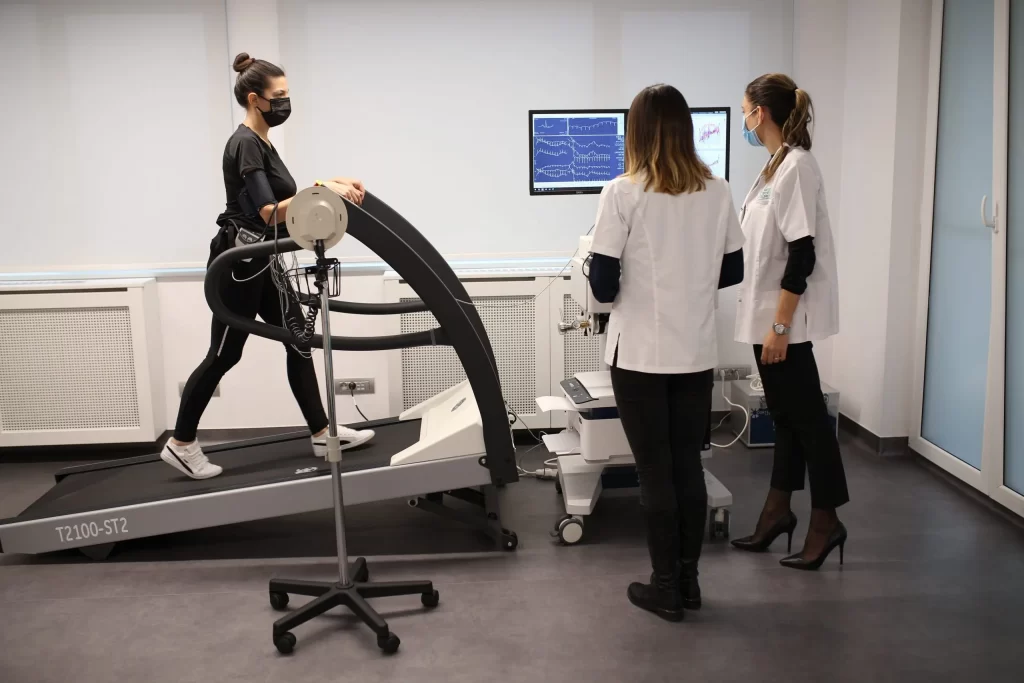
The cardiology specialists at Artro Sport Clinic use state-of-the-art, internationally leading technology to detect and treat the causes that can lead to sudden death. Cardiopulmonary exercise testing (CPET) is one of them; more complex than an electrocardiogram, it combines this analysis with data on how the lungs are functioning. This system can accurately diagnose cardiopulmonary exercise intolerance, and it is also used in the differential diagnosis of cardiovascular and respiratory diseases.
The CPET system, a revolutionary technology with applications in cardiology and beyond, is useful in pre-operative and post-operative assessment, in establishing an appropriate cardiopulmonary rehabilitation programme and in determining the risk of sudden death. This is important not only for athletes but also for people who exercise as a hobby. CPET technology is also very useful in preventive occupational health screening. Just imagine what it would mean for a pilot to suffer sudden death while the aircraft is full of passengers!
One of the parameters measured with CPET technology is the maximum volume of oxygen in the lungs, VO2 Max. It provides data not only on endurance but is also a very important indicator of health. Cycling and swimming enthusiasts, or people who regularly run on a treadmill, will find out through VO2 Max testing how their heart and lungs behave during exertion, because the technology simultaneously records the electrocardiogram results and correlates them with those from the exhaled air. In this way, the body's response to physical stress is also reflected by measuring the maximum volume of oxygen in the lungs, the volume of carbon dioxide and ventilation. Through these methods, CPET technology reveals the body's adaptation to exertion and the various conditions we may be suffering from, even if they have not yet manifested themselves.
Depending on the test results, the cardiology specialists at Artro Sport Clinic can recommend personalised types of exercise, tailored to each patient's needs. And, most importantly, with the highest-standard technology available at Artro Sport Clinic, cardiologists will be able to detect and prevent the onset of possible conditions that increase the risk of sudden death.
Newsletter subscription
Sign up for the Artro Sport newsletter free of charge!